



EV charging guide: Understanding different types of chargers
According to data from the Hungarian Association for Electromobility, nearly 80,000 green-plate vehicles are already on the roads in Hungary. Electromobility is therefore becoming increasingly widespread across the country, although questions about driving range and charging options continue to be among the most common concerns. One of the greatest advantages of electric vehicles is that they can be charged almost anywhere there is access to electricity. In practice, however, the situation is more nuanced, as charging speeds and charging times vary significantly depending on the type of charger being used. Drawing on the experience gained from managing a fleet of half a million fully electric and plug-in hybrid vehicles worldwide, we provide an overview of the available charging options and practical advice to help EV owners make informed decisions about where and how to charge their vehicles most effectively.
Home charging
The most practical charging option for electric vehicle owners is home charging, as the car can be recharged while parked in a garage or driveway. The simplest way to do this is by using the manufacturer-supplied charging cable that comes with the vehicle. These chargers typically operate at 10 amps and feature a Type 2 connector on one end and a standard 230 V household plug on the other. Such slow chargers draw power from either a single-phase or three-phase connection at 10 to 16 amps per phase, delivering an average charging power of around 3 kW. As a result, a fully depleted battery may require approximately 20 to 24 hours to reach a full charge. In practice, however, most drivers return home with some battery capacity remaining, meaning the actual charging time is usually much shorter. This so-called emergency charger is worth keeping in the vehicle at all times, as it allows the battery to be charged wherever a standard electrical outlet is available.
Before relying on this charging method at home, it is advisable to have a qualified electrician inspect the outlet and electrical installation to ensure they can safely handle the continuous load over the long term. It is also important to note that ordinary extension cords should not be used if the charging cable is too short, as prolonged high-current use may cause them to overheat and potentially create a fire hazard.
Home charging can be made safer and more convenient by installing a wall-mounted charging unit, commonly known as a wallbox. These systems often feature a permanently installed and connected charging cable, meaning the driver only needs to plug the connector into the vehicle. Compared with charging from a standard household outlet, a wallbox can provide charging speeds that are two to three times faster. Depending on the electrical supply, a wallbox can deliver between 7.4 and 22 kW of charging power, although it is important to consider the vehicle’s own charging capabilities when selecting equipment. Before purchasing a wallbox, consulting a specialist about the capacity of the existing electrical system is highly recommended, and upgrades should be undertaken if necessary.
Charging at the workplace
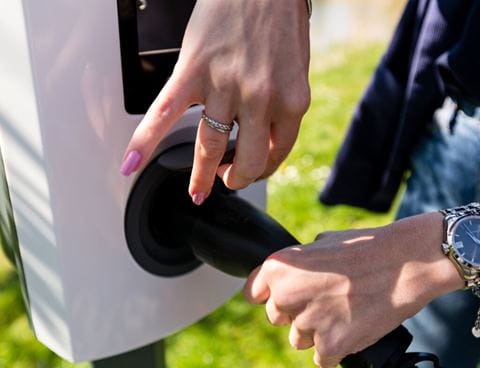
An increasing number of companies are installing EV charging stations for employees and visitors as part of their transition to electric fleets. Just as at home, vehicles often remain parked for extended periods during the workday, making workplace charging a convenient and efficient option. In most cases, charging is provided through equipment similar to home wallboxes, offering comparable charging speeds. Depending on the solutions implemented by the organization, charging can be started simply by plugging in the vehicle, using an RFID card, or via a dedicated smartphone application. In some workplaces, higher-powered direct current (DC) chargers may also be available. These chargers are typically capable of delivering charging rates of 50 to 75 kW and are often intended primarily for shared fleet vehicles that require faster turnaround times.
Public fast chargers
Often referred to as destination chargers, these charging stations are commonly found in the parking lots of shops, shopping centers, and hotels. Most of them are 11 kW or 22 kW alternating current (AC) charging stations. In many cases, they provide only a socket rather than a built-in cable, meaning drivers must use their own charging cable. When starting a charging session, it is important to ensure that the cable is locked on the vehicle side. As long as the cable remains connected to the car, it cannot be unplugged from the charging station. Once disconnected from the vehicle, however, it can be removed freely.
In terms of capacity, these chargers are essentially more powerful versions of home wallboxes. They are typically capable of supplying 10 to 16 amps per phase and are most commonly equipped with Type 2 connectors. The actual charging speed depends primarily on the vehicle’s onboard charger. Even if the charging station can deliver power through all three phases, charging will be limited if the vehicle is only capable of accepting power from a single phase. Charging at these stations is usually subject to a fee, and the charging session can typically be started through the charging provider’s mobile application.
Ultra-fast chargers
Chargers with a power output exceeding 50 kW are known as ultra-fast chargers and typically operate using direct current (DC). Their purpose is to deliver the maximum possible amount of energy in the shortest possible time, enabling drivers to continue their journeys quickly. For this reason, they are most commonly found along motorways and at fuel stations. Using an ultra-fast charger, an electric vehicle can reach up to 80% battery capacity in as little as 30 minutes. However, this type of charging places greater stress on the battery, so it is generally recommended to use it only when necessary. To protect the battery, the final 15-20% of the charging process is intentionally much slower. Therefore, it is worth considering whether a full charge is actually required, especially since maintaining a battery charge level between 10% and 90% is generally recommended to maximize battery lifespan. An exception applies to lithium iron phosphate (LFP) batteries, for which charging to 100% is both permissible and recommended.
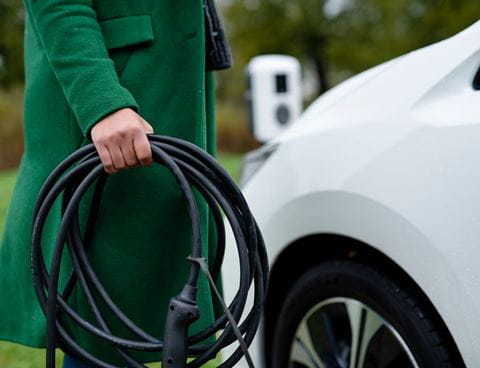
Ultra-fast chargers always come equipped with integrated charging cables. In Europe, two main standards are commonly encountered. CHAdeMO chargers are primarily compatible with older Japanese and South Korean vehicle models, while the CCS (Combined Charging System) connector is used by almost all other electric vehicles. Tesla vehicles can also use dedicated Supercharger stations, which typically offer charging capacities ranging from 120 kW to 250 kW. In Hungary, current regulations require ultra-fast charging stations to provide a CCS connector. Nevertheless, most charging points also feature a CHAdeMO connector, while triple-standard charging stations include both of these alongside a Type 2 connector for AC charging. The two DC connectors cannot be used simultaneously, although one DC connector and the AC connector can be used at the same time.
When using an ultra-fast charger, it is particularly important to follow proper charging etiquette. Charging bays should only be occupied while actively charging, as other drivers may also need access to the station. Vehicles should not be left unattended for extended periods, and charging spaces should never be used for parking if the charging service is not being utilized. Drivers should also be aware that some DC charging stations apply time-based pricing, which may continue to accumulate even after the battery has reached 100% charge.
.jpg?rev=1808f031abae47e0b459aac104e8a4a9&mw=600&io=transform%3Afill%2Cwidth%3A600)