


Charging on the go
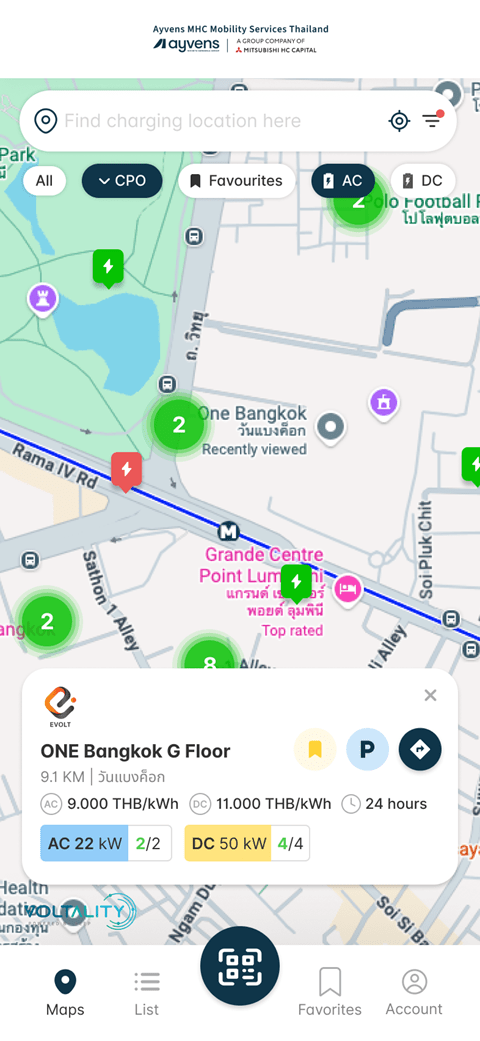
If you want to use a charger on the road, you can find multiple public chargers, at petrol stations and in various locations such as shopping centers. There are many Apps, but this is not so convenient due to lack of roaming across numerous Charge Point Operators (CPOs). To avoid ‘App fatigue’ we recommend using our App, it gives access to more than 4000 chargers across multiple CPOs, all visible and accessible with a single App.
Everything you need to know about charging on the go
- You start and stop charging with a charging card, SMS or QR code, through an App
- Using fast chargers is more expensive than regular public charging stations, it's good to consider if the speed advantage is worth it compared to the higher cost
- You can find charging stations by using Apps or the car's navigation system
There are two different types of fast chargers: traditional fast charging and rapid charging. In short, this means that the battery receives a lot of power in a short time, and if you use rapid charging, you get more power than with traditional fast charging. Of course, there is a difference in how much power the different cars can receive.
With a fast charger, the charger itself is moved out of the car. This charger has high capacity and bypasses the car's built-in charger. This makes the charging time much shorter than if you were to charge on a home-installed charger.
Where do I find fast chargers?
We recommend subscribing to Ayvens MHC Mobility Services Thailand charging service offered by our partner Voltality. With a single App you are able to locate chargers across multiple CPOs.
How do I use a fast charger?
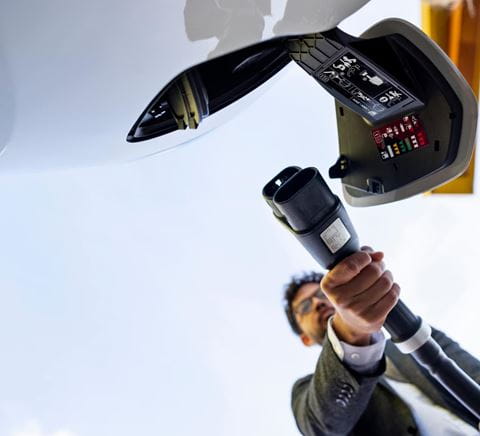
- Park your car so that the charging cable is long enough to connect.
- With fast chargers and rapid chargers, you do not need to bring your own charging cable. The chargers have built-in cables.
- Connect the correct cable to your car. Many charging stations have two cables with both ChaDeMo and CCS charging standards, but only one of them can be used at a time.
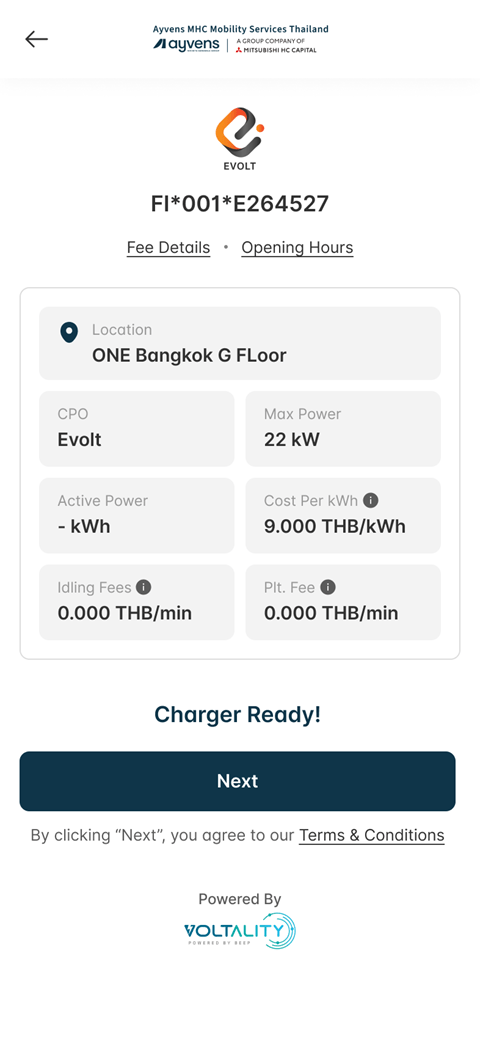
- Follow the instructions on the charging station's screen or notice; either scan the charging card, start via app, or SMS. If you use our App follow the instructions,
How long should I fast charge?
- Make sure to have as much power as possible when you leave home. Then it's a long time before you need to charge, and when you do need to charge, the battery is warm and accepts much more power faster than a cold battery.
- If you start charging when the battery is between 10 to 20 percent, you will charge the fastest. This assumes that the battery is warm enough. You get a warm battery if the car has been driven for a long time or has a built-in system that gives the battery the right temperature before charging.
- End charging when you have between 80 and 90 percent. As the battery approaches full, the charging speed decreases to protect the battery. It's faster to make an additional short charging stop if you need more power to get there.
7.4 kW power output
- 50 kWh EV battery7h45m
- 75 kWh EV battery10h
11 kW power output
- 50 kWh EV battery5h15m
- 75 kWh EV battery6h45m
50 kW power output
- 50 kWh EV battery53 min
- 75 kWh EV battery1h20m
150 kW power output
- 50 kWh EV battery18 min
- 75 kWh EV battery27 min
Benefits of our charging solutions
| Ayvens MHC - Voltality | CPOs subscriptions | ||
Availability “Are there any public chargers installed?” | Multiple CPOs | 1 CPO | |
Discoverability “Can I easily find available charging stations?” | Multiple CPOs | 1 CPO | |
Accessibility "How can I use this charger?" | Single App | Many Apps | |
Simplicity "Can I handle charging with a single App at any station?" | Yes | No | |
Transparency "Can the App let me know how many kWh I get and for how much?" | Yes, all CPOs | Not always | |
Reporting "Can I manage all my drivers through 1 platform?" | Yes | No | |
Invoicing "Can I get a single unified monthly bill?" | Yes | No | |
How much does public charging cost?
The costs for public charging depend on CPO of the charging station. Prices may include a start fee (one-time fee) and can be based on either per minute or per kWh.
Minute-based charging: The operator charges you based on the time your car is connected to the charging station. This means you pay as long as you are parked at the charging station, even after charging is complete.
Charging per kWh: This operator charges based on kWh consumption in combination with the parking time at the charging station.
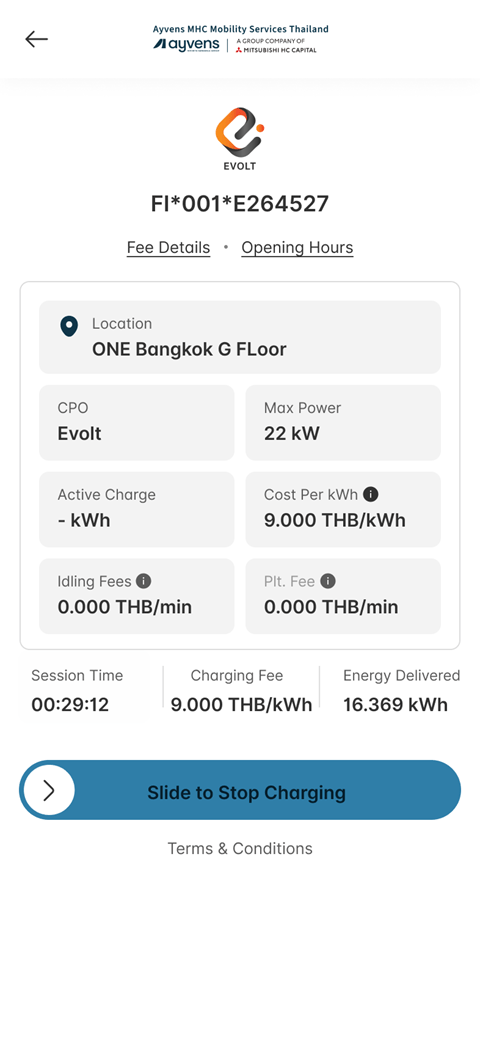
With our charging service the App is connected to the charging station of the contracted CPOs, this provides transparency on the number of kWh charged, the cost per kWh and any other fees, if applicable. You are in control with no bad surprises to expect when your employer receives the bill.
When you have a corporate lease with us, the costs of charging the car are covered by the employer via our agreement with our partner Voltality. Check with your employer what is allowed regarding charging at public stations, which is more expensive than home charging and workplace charging.
Geolocation of nearest charging points with availability and price conditions
Start charging service with the App
Control, end charging session with the App