



Tire Guide: How to save money by paying attention to these key factors
For many motorists, switching to summer tires is an essential spring ritual. Some drivers get it done as early as the beginning of March, while others wait until the first truly warm days arrive. Whichever group you belong to, it is important to remember that tires have a limited lifespan, which is why they deserve attention throughout the year, not just during seasonal tire changes. That’s why we summarized the most important things drivers should keep in mind.
Whether we use our cars for daily commuting or longer journeys, tire selection, maintenance, and timely replacement play a crucial role in vehicle performance, handling, fuel efficiency, and road grip. Since tires are the vehicle’s only point of contact with the road, even the simplest maneuver can become dangerous if they are not in proper condition.
All-sea son vs. winter and summer tires
Safe driving begins with choosing the right tires. Passenger car owners can decide whether to use all-season tires or maintain separate sets of winter and summer tires. All-season tires provide adequate grip throughout the year and in a wide range of weather conditions. They generally offer a long service life and are now suitable for most passenger cars and SUVs. These tires combine the characteristics of both winter and summer tires. However, they cannot quite match the performance of dedicated seasonal tires, which are specifically engineered to excel even under extreme weather conditions.
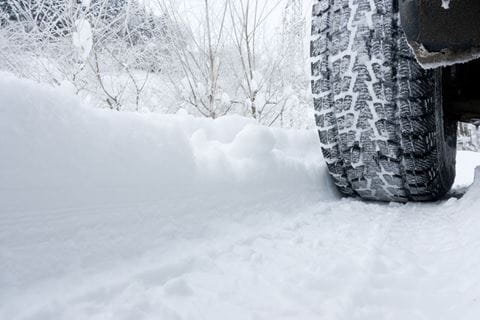
One reason for the superior performance of winter tires is their heavily siped tread pattern, which optimizes braking and handling on snow- and ice-covered roads. These tires are designed for temperatures below 7°C (45°F). Their softer rubber compound remains flexible in cold weather, but at higher temperatures it wears more quickly and provides less effective grip. This is where summer tires come into play. Their defining features are a harder rubber compound and a tread pattern with larger blocks, designed to deliver excellent traction on both dry and wet roads at temperatures above approximately 7°C (45°F). However, summer tires are not suitable for cold, snowy, or icy road conditions. Their grip decreases significantly on cold surfaces, and in snowy or icy environments they are simply not designed to provide the level of safety required for reliable driving.
Size and speed rating
In every tire category, there are more expensive products that may seem superior at first glance. However, a higher price does not necessarily mean a better choice in every case.
A tire’s size specifications are indicated by a combination of letters and numbers printed on the sidewall. For example, “215/65R15” means that the tire has a tread width of 215 mm, an aspect ratio (the sidewall height as a percentage of the tire width) of 65%, a radial construction (indicated by the letter “R”), and a rim diameter of 15 inches. When replacing tires, only those tire sizes and specifications that have been approved by the vehicle manufacturer for the specific model should be used. This information can usually be found on the inside of the driver-side door pillar or in the vehicle’s owner’s manual. Special attention should be paid when purchasing a used vehicle, as these often come fitted with replacement tires that may not meet the manufacturer’s specifications.
The tire’s load index and speed rating are also displayed on the sidewall, immediately following the size designation (for example, “91S”). The numerical value indicates the load index, specifying the maximum weight the tire can safely support. For instance, a load index of 91 corresponds to a maximum load capacity of 615 kg (1,356 lbs) per tire. The letter represents the speed rating, which indicates the maximum speed at which the tire can be safely operated under ideal conditions. For example, an R speed rating corresponds to a maximum speed of 170 km/h (106 mph), while an S rating indicates 180 km/h (112 mph), and the scale continues accordingly. Expert guidance on selecting the most suitable tires is readily available at specialized tire service centers and workshops.
Of course, our responsibility does not end once we have chosen the right tires. As we drive, tires gradually wear down, and the rate of wear is reflected by an official measurement known as the treadwear grade. This value provides an indication of the tire’s expected lifespan by estimating how long it will take for the tread to wear away. However, it is important not to rely on a fixed replacement date, as tread wear is influenced by a variety of factors, including driving habits, road conditions, and weather patterns.

When should tires be replaced?
According to regulations, tire tread depth must be at least 1.6 mm. Falling below this limit can result in penalties if the tires are not replaced. However, industry organizations and general manufacturer recommendations suggest higher thresholds for safe driving: 3 mm for summer tires and 4 mm for winter tires. In fact, under many regulations, a winter tire with less than 4 mm of tread depth is no longer considered a winter tire. These recommendations should be taken seriously. According to research by AAA, worn tires can increase braking distances by as much as 43% on wet roads at highway speeds, resulting in an average of 26 additional meters (85 feet) of stopping distance compared to new tires, which is longer than the length of a full-sized truck.
Wear is not the only thing to watch for. UV radiation also affects tires, gradually breaking down the rubber compound and causing cracks, even when the tread still appears to be in good condition. Potholes, curbs, and other impacts can also cause damage. Small cracks can develop into larger splits over time, potentially leading to tread separation or a blowout. A bulge or blister on the tire sidewall is typically the result of impact damage caused by hitting a pothole or curb. In such cases, the tire should be replaced immediately, as even a small sidewall bulge can easily lead to a sudden blowout. Uneven tread wear is another warning sign.
If the tread does not wear evenly across the tire surface, it is worth investigating the cause, as issues such as suspension misalignment, improper wheel balancing, or incorrect tire pressure may be responsible.
Maintenance
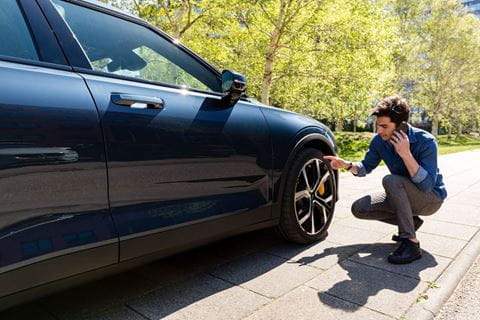
It is advisable to inspect tread depth and the overall condition of your tires as frequently as possible, and the same applies to tire pressure. If you are unsure about the correct tire pressure for your vehicle, look for the sticker or information plate located on the inside of the driver's side door. In addition to the manufacturer-recommended tire sizes, it also specifies the correct tire pressure values. The same information can be found in the vehicle owner's manual.
Ayvens’ tips for tire maintenance
1. Tire rotation and balancing Regular tire rotation and balancing help ensure even tread wear. This is necessary because the front tires typically wear out faster, as they carry the weight of the engine and bear the load of steering and cornering. Therefore, rotating the tires from time to time can help extend their lifespan. Tire rotation is generally recommended every 8,000 to 13,000 kilometers, but the exact interval and rotation pattern (e.g. front-to-rear or cross rotation) can be found in the vehicle owner’s manual. 2. Proper tire pressure An underinflated tire heats up more quickly and wears out faster, while also reducing vehicle stability. An overinflated tire tends to wear more in the center of the tread and provides less grip. Use a tire pressure gauge and check your tires regularly, including after the vehicle has been parked for an extended period. 3. Keep the vehicle moving Whether your tires are new or older, it is important to drive the vehicle regularly, ideally every week, to help distribute the load evenly across the tires. 4. Trust the professionals Do not visit a service center only for mandatory inspections. A complete vehicle check-up, including tire inspection, is recommended at least once a year. Tire replacement is also best left to professionals, as many safety-related factors cannot be properly assessed at home. Specialized tire service centers use dedicated equipment specifically designed to inspect tire condition and safety. 5. Change tires at the right time Follow the 7°C rule: switch to summer tires once the average daily temperature remains consistently above 7°C, and switch to winter tires when it consistently falls below 7°C. Do not wait for extreme weather conditions, as driving can become unsafe much sooner than most people realize.