


The road to child-friendly mobility: how far can a child go on their own?
Answer: as far as the route feels safe. Child-friendly mobility is not about having fewer vehicles. It is about a child's freedom to travel independently and the sense of safety that makes that freedom possible. In this article, we take a closer look at the theme of the 2026 Mobility Week. What is it about? Why do children have less freedom to move around independently today? And what can we do about it, including as an employer?
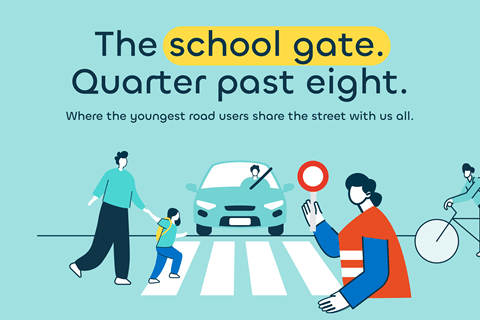
The school gate, 8:15 a.m.
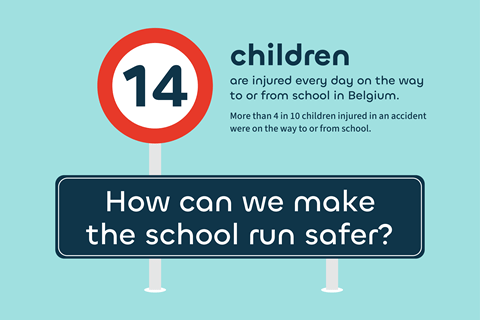
Pedestrians and cyclists, cargo bikes and scooters, cars and vans, even the occasional truck, all weaving through the same space. It’s a hectic scene. A father watches his daughter until she disappears through the school gate. She knows the route by heart. Yet he still walks her to school every morning because the streets don’t feel safe. And often, they aren’t: every day in Belgium, fourteen children are injured on their way to or from school.
How far should a child be allowed to travel independently? It’s a question every family faces sooner or later. The answer is simple: a child’s freedom extends as far as the route feels safe.
What is child-friendly mobility?
It means designing streets and routes from the perspective of children, the most vulnerable road users. If an environment is safe for a child, it will also be safe for people who are less vulnerable.
Today, two initiatives are helping to reshape the way we think about mobility. The 8-to-80+ principle of the Flemish Road and Traffic Agency states that a street where both an 8-year-old and an 80-year-old can move around safely works for everyone in between. The Child Standard (Kindnorm), developed by the Family League and endorsed by the Children's Rights Commissioner, calls for every mobility decision to take its impact on children into account. Through the Child Standard Coalition and organisations such as Mobiel 21, this translates into measures such as safe cycling and walking routes and the reduction of heavy traffic around schools.
And it works. In 1992, 90 children under the age of 14 lost their lives in traffic in Belgium. By 2022, that number had fallen to eight. According to Vias Institute, safer infrastructure and the introduction of 30 km/h zones around schools have been key factors behind this decline.
The turning point: moving on to secondary school
In 2023, Vias Institute, Belgium’s independent knowledge centre for road safety and mobility, surveyed 640 Belgian children aged 10 to 14 about how they travel to school. Among 10- and 11-year-olds, 36% travel to school independently. Among 12- to 14-year-olds, that figure rises to 51%.
The conclusion? Almost everything changes when children move on to secondary school:
- Who they travel with. Of the children who do not travel alone, 63% of 10- and 11-year-olds are accompanied by a parent or another adult family member. Among 12- to 14-year-olds, that drops to 38%. Meanwhile, the share travelling with friends increases from 11% to 32%.
- How they travel. The use of public transport jumps from 8% among 10- and 11-year-olds to 26% among 12- to 14-year-olds. The proportion driven to school by car falls from 23% to 14%.
- Where they travel. Secondary schools are often located farther from home, in a different neighbourhood and along busier roads.
In other words, children suddenly find themselves travelling longer, less familiar and busier routes, either alone or with peers who are just as inexperienced. It is therefore no coincidence that, according to Vias, the risk of being involved in a traffic accident increases most sharply around this age.
Rush hour: when the feeling of danger peaks
Children are allowed to go out on their own at increasingly older ages. Many people agree on the reason: traffic. Fifty-six percent of parents consider cycling dangerous because of the surrounding traffic (Child Standard Coalition/Mobiel 21). The morning rush hour does coincide with the school run.
And that goes straight to the heart of the issue: much of the traffic that makes the journey to school feel unsafe is traffic on its way to work.
- 8 years old: the age to start exploring independently?
The Children’s Rights Commissioner believes that, from the age of 8, children should be able to travel short, familiar routes on their own in a safe environment. In practice, however, it is only around the age of 12 that half of all children go to school independently. Read more on kinderrechten.be.

Who makes the journey to school safer?
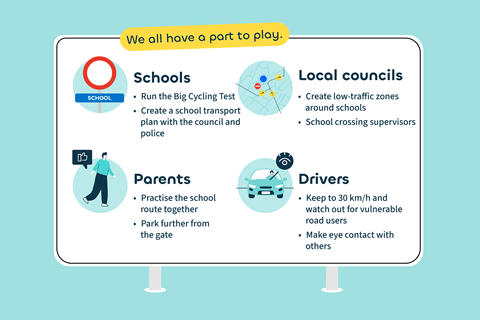
If a child’s freedom extends only as far as the route feels safe, then the question becomes: who can help make that route safer? The municipality and the school, certainly. But parents and passing drivers also play a role. Even employers can influence safety around the school gate.
The municipality shapes the street environment. Since 2018, low-traffic school zones and school streets have been embedded in the Belgian Highway Code, with their own traffic sign and specific rules. Crossing guards are also appointed by the mayor.
The school knows the local traffic challenges best. Through a school mobility plan, which is mandatory in Brussels, schools identify these challenges together with local authorities and the police. Cycling proficiency tests also help children develop the traffic skills they need to travel safely.
Parents know the route between home and school. Practising that route repeatedly and together is essential. Drivers, meanwhile, either stop at the school gate or pass by it. Respecting the 30 km/h speed limit, anticipating children who may suddenly cross the road, and making eye contact at pedestrian crossings are all essential behaviours around schools. They cost nothing and require no policy changes.
The employer determines working hours and mobility options. A broader range of mobility solutions, flexible start and finish times, and a mix of office and remote work can all help reduce pressure during peak traffic periods.
We make the streets around school gates safer together
The question of how far a child can go on their own is not about courage or age. It is a question about the street environment and the potential dangers it presents. The good news is that creating safer streets is a shared responsibility. As the Week of Mobility 2026 aptly puts it: a street designed with children in mind is a street that works for everyone.
Sources: Gezinsbond, Local Police, Mobiel 21, Vias, VSV, Belgian Highway Code.